|
Last week was APIDays London week, and the days before you
get on a plane to talk about APIs are a good time to find
out whether what you are going to say to everyone is still
true.
So I did two things before I left. I re-scored twenty-six thousand companies on the Kin
Score, five days ahead of the date I had pinned it to, so that
a full re-score would not be the last thing I did before
getting on a plane. And I read all 110 sessions on the APIDays London agenda and
mapped every one of them to the facet of the Kin Score
it speaks to. Agent readiness was the main subject of 33 talks and
came up in 61.
The industry spent the same week answering a question the
agenda only gestured at. Last week everyone rebuilt the
front door for agents. This week they put the money behind
it.

|
|
A dark neon city of angular structures where a tall
gateway arch stands over a luminous causeway, a
small glowing slot set into each pillar sparking as
a stream of small light-vessels passes through.
|
The Agent Got a Wallet
-
Cloudflare opened Monetization Gateway in closed
beta. Sellers define which requests require payment, what
they cost, and where the money goes — for APIs, MCP
tools, sites and datasets. The New Stack asked the
right follow-up in its headline: Cloudflare brings paid access to MCP tools, so who
controls the agent's spending? Nobody has a good answer to that yet, and it is
going to matter more than the price.
-
AWS Marketplace shipped an AI agent skill for
usage-based metering — an agent-guided way for sellers to build and
validate pay-as-you-go metering from inside their
coding assistant. The meter is now something an agent
helps you build.
-
I spent the week on the provider's side of the
same idea. Pipedrive put a price on every tool call: 371 x-token-cost values across its operations, from 1 to 40, sitting
right underneath an agent-facing description. Every
operation in the API is priced, in the contract, where
an agent can read it before it calls.
-
The cost-control layer kept forming around it. Kong pitched AI Gateway as the place to take
control of the economics of AI and shipped Kong AI Gateway 2.2. Cloudflare's AI Gateway now shows where a
model is more capable than the task needs. Telnyx gave each team its own models, budgets and
guardrails. And the most concrete number of the week came from
Meta and Google: Instagram Direct cut token cost per agent session
by 33% by rebuilding the UI architecture underneath it.
-
Agentic commerce is no longer hypothetical in the
data. Forter published what AI agents are already
ordering on its network across August and September. Auth0 wrote up securing agentic commerce with the
Universal Commerce Protocol. And DatoCMS made the point most of the commerce
conversation skips: shopping agents decide what to recommend by reading
your content, so the content is the storefront.
Two weeks ago this newsletter was about the bill the agent
runs up. This week it is about the bill the agent pays.
Those are the same meter read from opposite sides, and the
description layer — what an operation is, what it costs,
what it needs — is the only place both sides can read the
same number.
|
|
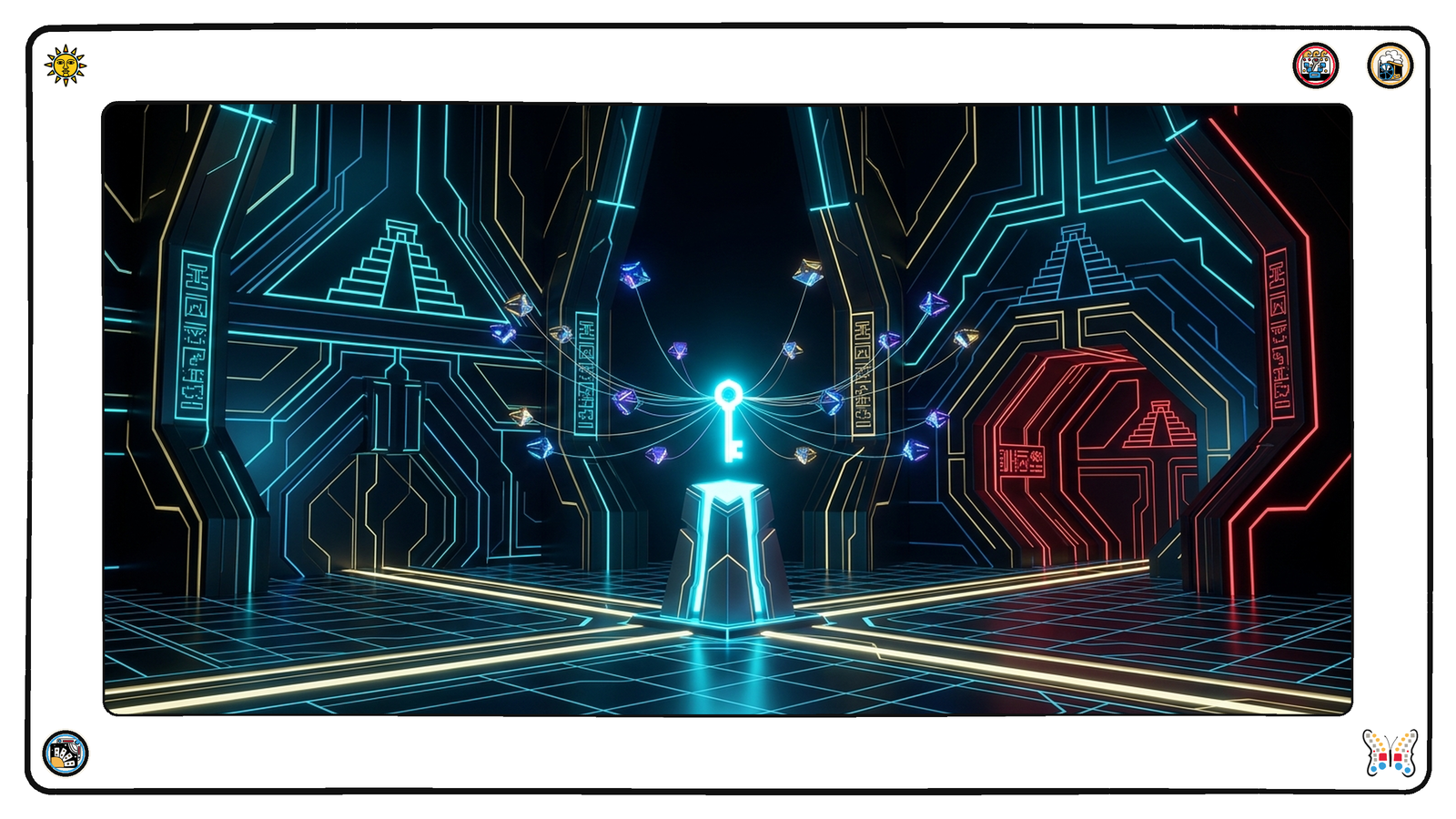
A dark neon vault hall where a single bright key
rests on one central pedestal, and a ring of small
light-vessels hovers around it, every one tethered
to that same key by a thin thread of light.
|
Three MCP Auth Bugs in Thirty Days, One Root Cause
Last week I wrote that WorkOS had the best-titled post of
the week. They have the best-titled post of this one
too: three MCP auth bugs in 30 days, one root cause —
trusting what the other side said. The MCP Python SDK, the Rust SDK and LiteLLM each
accepted authentication input that nobody verified.
-
The good news is that the fixes are now arriving in
the specification and the SDKs, not just in blog
posts. The official MCP SDK shipped DPoP and scope
challenges, turning the 2026-07-28 spec's authorization
hardening into code. Cloudflare's Workers OAuth Provider went v1
with full support for MCP 2026-07-28, splitting the authorization server from the MCP
resource server. Qlik now supports OAuth Client ID Metadata
Documents for MCP connections. Those are the unglamorous
pieces that make agent auth work without a human
pasting a key somewhere.
-
The bad news is the gap that is left. Bifrost's MCP flaw shows the protocol still
has no client-authentication story. An MCP event subscription is a credential, and almost nobody is treating it as one. CoPhish turned an agent-building platform into an
OAuth phishing vector.
-
And the credential problem underneath all of it got a
number. VentureBeat reports that 22 of 37 surveyed companies that enforce AI agent
permissions still have agents sharing credentials — which means they can enforce a permission but
cannot tell you which agent used it. Akeyless walked through the limits of vaulting
agent credentials, using Unit 42's prompt-injected AgentCore
agent that stole and replayed a credential that was
stored correctly.
-
The answers being built all look the same: let the
agent use the credential without ever holding it. DigitalOcean on how it manages credentials for
autonomous agents. Lit Protocol's Agent Keychain, with an honest section on what it does not protect
against. GitGuardian's look at AWS Dogwood and stateful
authorization for agents. And on the standards side, WorkOS on SCIM for AI one year later — the two competing IETF agent identity drafts are
now one draft, written together.
-
If you are choosing where to put that middle layer, WorkOS compared the MCP gateways from Cloudflare,
Okta, Auth0 and Microsoft, including what your MCP server still has to do
itself. That last part is the part to read.
📄 The Pricing of AI APIs — Cloudflare will now let you charge an agent per call,
and Pipedrive has already priced every operation it has.
Before you put a number on yours, look at how the model
labs do it. They turned out to be the most
pricing-transparent class of API provider I found anywhere
in the catalog — real per-token rates, the discount levers
the headline number hides (caching, batch, committed use),
and where pricing hides everywhere else — and that
transparency is the lesson. This paper ends with a plain
playbook for pricing your own API. $25

|
|
A dark neon hall opening onto a vast field of tiny
beacons, almost all of them dim and only a rare few
burning gold, while one thin scanning beam cuts
across the whole field.
|
Ninety Thousand MCP Servers Scored, and 0.28% Earn an A
This was a measurement week, and I was not the only one
doing it.
-
Arcade's ToolBench rescored more than 90,000
MCP servers and 630,000 tools, six months after its first pass.
Only 0.28% earn an A, and the finding
I would underline is the other one in their summary:
the riskiest tools get the least documentation. That
is backwards, and it is the kind of backwards that
only shows up when someone counts.
-
WorkOS on what 15,465 ungoverned MCP servers tell
us about the authorization gap — a registry audit that counted servers rather than
security controls, and why that number matters more
than it sounds like it should.
-
TestMu found that 66% of live registry MCP servers
return server instructions at connection time, which makes the instructions
field a prompt-injection surface before a single tool
is called. Their companion piece on regression-testing a stateless MCP migration is the practical one for anyone moving to the new
spec.
-
And the governance products shipped to match: Snyk's Evo agent-behavior governance went GA,
starting with MCP, and Salt launched continuous MCP server visibility for
Claude Enterprise.
My own numbers moved too. Kin Score 0.23 moved 25,659 of 26,192 composite scores — 7,456 up,
18,203 down, a median change of −0.8 — and 2,078 providers
changed band. I did not re-cut the bands; no band's
share of the catalog moved by more than 1.4 points. I
wrote out the standards that make your business agent-ready — nineteen dimensions, 139 points, almost every one of
them a published standard — and started walking through the Kin Score facet by facet.
I also had to correct myself, publicly. I have been saying
"16% human" about my own traffic for months. I re-measured it, and I had it backwards: 17.6% of 11.7 million requests across 27 sites came
from something that declared itself an AI agent.
Sixteen percent was never the human share. It was the
share that tells you it is a bot.

|
|
A dark neon workshop where three tall racks stand
side by side holding the same luminous tools, and a
small angular light-vessel hovers between them,
choosing.
|
MCP, CLI, Skills, or Your Own Agent
Measured the same way as last week, I
count 77 third-party posts naming MCP in
a title this week, out of 7,411. Thirteen
of those are PyPI package releases rather than posts; take
them out and it is 64. Last week,
re-counted today with the late-arriving posts included,
was 65 out of 6,260,
or 63 without its two PyPI releases — I
published 61 out of 6,061, and the corpus filled in after
I counted. So MCP held at roughly one post in a hundred
for the third week running.
The more interesting thing is what the posts are now
arguing about. It is no longer whether to ship MCP. It is
which surface to ship it through.
-
Arize introduced its AX MCP with a post on when to
use MCP, a CLI, or skills, and its framing is the right one: the question is
not which one wins, it is where the agent runs and who
is asking. Sentry wrote the same post from its side — Seer, the MCP server, the CLI, or your own coding
agent. Apify asked whether you should build an agent or an
MCP server, including what a connection costs in context.
Retool wrote a version of this last week and Postman
the week before. That is five vendors in three weeks
publishing the same decision tree.
-
Google did something worth noticing: a remote MCP server for the Google Cloud CLI, powered by gcloud and bq. The CLI, served as MCP. And the AWS MCP Server arrived in six more regions, which is the kind of announcement you only make
about infrastructure.
-
Skills kept arriving as their own artifact. AWS published best practices for writing DevOps
agent skills, and Chainguard asked how you harden an agent skill — "the simple file type with serious
complexities" is exactly right.
-
The launches: Recorded Future, Zyte, CompStak's Agent Connect (sold as its own tier, which is the commerce section
again), and Supabase, which now gives every app its own MCP
server for its users' agents. And the help-centre pattern continued — Podia published five MCP pages in a day, from getting started to security and
troubleshooting.

|
|
A dark neon drafting table where one luminous
blueprint lies unrolled with three different
controls on it, a toggle, a dial and a lever, each
casting a different coloured beam onto the same
point.
|
From My Desk: One Key, Three Shapes
Across 7,411 third-party posts, OpenAPI appeared in two
titles, and one of them was a CISA vulnerability advisory.
The other was Geoapify publishing its OpenAPI specs for AI coding
tools — which is exactly the right reason to publish one in
2026, and I wish more providers framed it that way.
-
The x-mcp series. Three companies in my
catalog use an OpenAPI extension called x-mcp, and none of them knows the others exist. Demodesk has the richest version — an object with enabled, toolName and title. Eon writes a bare boolean, with two undocumented
dialects in the same document. And Ripio wrote enabled: false, which a tool expecting Eon's bare boolean
will read as true. That is the post I would hand to anyone who thinks
unregistered vendor extensions are a tidiness problem.
They are a bug that inverts an exposure decision.
-
Upsert. A LinkedIn question asked why
upsert is not required of every CRM API, so I measured
it across 119,154 OpenAPIs from 8,006 providers: ten percent have upsert, and one percent tell you
what it did.
-
OpenAPI 3.2, a year later. Fastify now speaks OpenAPI 3.2. One line of release notes, and the kind of release
I pay most attention to — a specification version only
becomes real when the code-first frameworks that
generate contracts can produce it.
-
The Kin Score, facet by facet. Discoverability, contract quality, contract governance and developer ergonomics so far. And the four ways providers react to a Kin Score: silence, a takedown request, a roadmap, or a pull
request.
-
The view from outside. You cannot see your own API from the outside — everyone tests from inside their own advantage,
logged in, on the VPN, with the environment variable
already set.
-
And one ask. I am looking for design partners for APIs.io On-Premise. The profiling that powers the public catalog now
runs on a box, which means the question I have been
answering "not yet" for twelve years — can I run this inside my company? — finally has a different answer. If your
organization cannot say what APIs it has, I would like
to talk.
I want to end on the thread connecting the money and the
keys, because it is the same thread. Cloudflare will let
you charge an agent per call. Pipedrive already priced
every operation. And twenty-two of thirty-seven companies
cannot tell you which of their agents made a given call,
because their agents share a credential. You cannot bill
an identity you cannot see.
Charging agents is going to make the identity problem
urgent faster than any security incident has, because
unattributed spend gets noticed by finance, not just by
security. The companies that can say, in a contract, what
each operation costs, which identity is calling it, and
what it is allowed to do will be the ones that can
actually get paid.
See you next week.
🔌 APIs.io — read any provider's Kin Score for a
penny — Since I spent this issue on agents paying per call,
here is ours, described plainly.
Every provider's Kin Score page is free to read in a browser. Through the API, one
provider's rating, its facets, or its rating history
costs $0.01 per call on
the Access plan — with a card, or paid
with x402 in USDC with no account at all.
Call it without a key and the 402 response tells an agent
how to pay for that one request. The 0.23 movers — who
went up, who went down — are $0.05 a
call, and the whole scored dataset is
the Understanding plan.
curl -i "https://apis.io/api/v1/providers/stripe/rating"
And the catalog's 6,714 MCP server profiles remain free, no key, no tier.
|